

There is a situation that many SME managers describe in the same way. Their business is doing well. Their existing customers are loyal. Word of mouth works. And yet, on some calls for tenders or certain incoming requests, they discover that the prospect first contacted two or three competitors that he had found on Google. Their name was not in the results.
The problem of Google visibility of an SME vs. its competitors is not a problem of reputation or quality of service provided. It’s a structural internet visibility problem, which grows every month as the situation remains unchanged, as your competitors take a better position in the search results on your business queries.
To remember
- More than 80% of B2B decision-makers do research on the internet before contacting a service provider: an SME that is absent from the top positions on its business queries is simply not in the field of consideration of prospects who do not already know it.
- Three structural causes explain the invisibility of an SME on Google: chronic underinvestment in SEO, the absence of SEA ads on queries with commercial intent, and the lack of knowledge of GEO (referencing for generative AIs such as ChatGPT, Claude, Perplexity and Google AI Overviews).
- The Google business listing is often the first thing a prospect consults before even clicking on the site: a listing without follow-up (unanswered reviews, missing photos, outdated description) degrades online reputation in a few seconds.
- The GEO imposes specific work on the structure of the content (short paragraphs, explicit questions, answers dense with factual information) to maximize the chances of being cited by generative AIs in their summaries.
- SEO and SEA are not in competition: SEA captures active demand in the short term, SEO installs sustainable visibility over six to twelve months, and GEO opens up an acquisition channel that is growing rapidly.
What customers no longer search for in the same way on Google
Internet research becomes the first thing a prospect does
For a long time, an SME could thrive on its network, referrals, and local presence. This model has not disappeared, but it has become considerably weaker.
According to the France Num 2024 Barometer, more than 80% of B2B decision-makers do research on the internet before contacting a service provider. This figure is even higher for new entrants to a market, those who do not yet know the local players and who logically start with a Google query. For them, typing a keyword into Google is the first thing they do before picking up their phone.
An online presence that determines access to new customers
This behavior turns online presence into a prerequisite for business contact, not an optional benefit. A company that is absent from the first results on its business queries is simply not in the field of consideration of new customers who do not already know it.
Conversely, an SME visible on Google on the right queries captures a regular share of the latent demand. It appears in the search results at the moment when a need is formulated, which is the exact opposite of outbound prospecting: it is the prospect who comes to it, with a purchase objective already identified.

The asymmetry of visibility on the internet that is silently widening
The role of content and positioning against your competitors
The problem is not static. It is getting worse as some market players invest in their digital visibility and others do not.
A competitor who regularly publishes quality content, who has put his internal linking to work, who manages Google Ads ads on commercially intended queries in your sector, and who is starting to be cited by generative AIs such as ChatGPT, Claude or Perplexity, is building a structural lead. He is not necessarily better than you in terms of service rendered. It simply occupies a higher position in the search results at the time your prospects are searching. Its content does its job for it, day and night, at no marginal cost.
A loss of leads you don’t see
This asymmetry has an important characteristic: it is invisible to the person who suffers from it. You don’t see leads that you don’t receive. You don’t know how many prospects searched for your type of service this month, found three names, and started their buying process without ever coming across yours.
To measure the gap, all you need is a simple exercise: for example, type your business queries at the top of Google and see who appears. If your website is nowhere, your prospects are already in the hands of your competitors before you even know they are interested.
The three common causes of an invisible SME on the internet
Chronic underinvestment in SEO and content strategy
The first cause is chronic underinvestment in SEO, also known as search engine optimization. Many SMBs have a decent site, but no active content strategy. Their pages don’t answer the questions their prospects actually ask on Google. Their blog posts, if they have any, were published two or three years ago, with no thought on search intent, no long-tail work, and no internal links to direct bots to priority pages.
This underinvestment is rarely a deliberate refusal. It is rather a lack of priority in a calendar where other subjects have always seemed more urgent.
Lack of ads on business-intent queries
The second cause is the lack of ads on commercial queries. SEO produces results over time. Google Ads ads allow you to immediately appear on queries where someone is looking specifically for what you do, with explicit purchase intent. Many SMBs have never activated this lever, or have activated it without serious landing page optimization. The result: a budget spent, visibility on Google effective, but a drop in conversion rate and a high bounce rate on landing pages.
Lack of knowledge of GEO for generative AI
The third cause is the lack of knowledge of GEO, the referencing for generative AIs. Since 2023, a growing share of professional searches has been carried out through conversational interfaces such as Google AI Overviews, ChatGPT or Perplexity. These tools cite sources. They recommend service providers. They offer a summary of the options available in a market. An SME whose content is not structured to be taken up by these systems simply does not exist in this new channel of influence, even though the quality of its service deserves to be included.
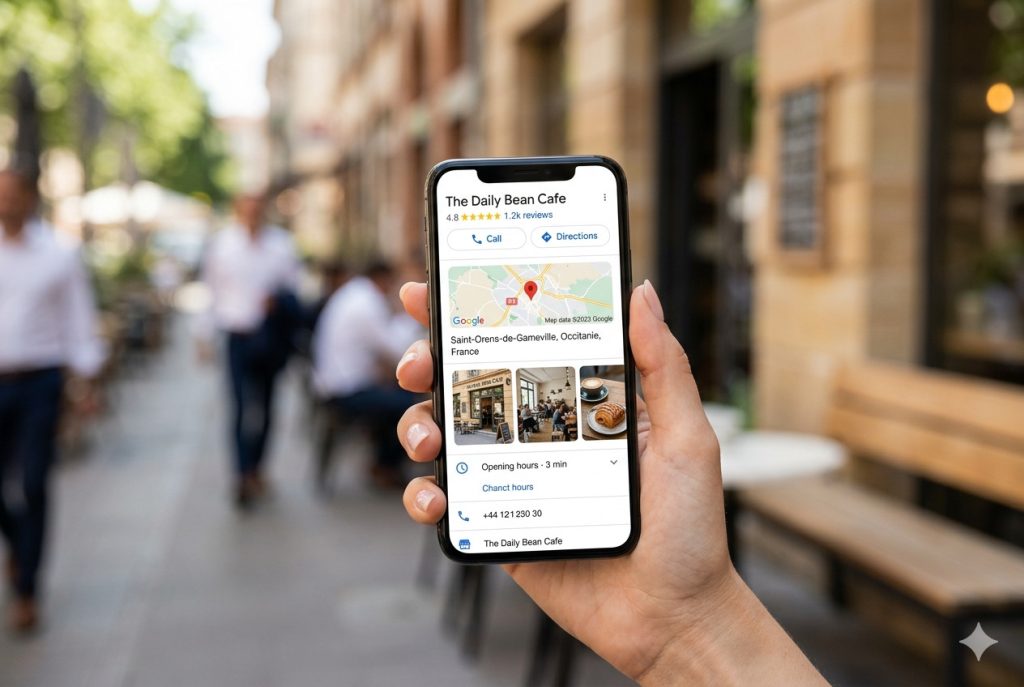
The Often Overlooked Role of Your Business’ Google Listing
The Google listing as the first online showcase
The Google Business Profile plays a strategic role that is often underestimated by SME managers. It is the one that appears on the right of the search results when a prospect types in your name or types in a geolocated search such as “your job + your city”. It contains your address, opening hours, a short description , photos, customer reviews , and a link to your website.
For many prospects, the Google listing is the first thing they look at before they even click on your website. It is a foundation of trust that is built or destroyed in a few seconds.
Reviews, online reputation, and credibility of your business
Reviews on your Google listing directly contribute to your online reputation. A negative review without a response weighs more heavily than a negative review with a measured response. The number of reviews, how often they are published, and the quality of the company’s responses are all signals that Google uses to decide your local positioning, and so many signals that prospects read in a matter of seconds to assess your credibility.
Many SMEs leave their Google listing untracked, without recent photos, without an up-to-date description. This is a costly communication mistake to correct once reputation has taken hold.
What digital visibility actually does for your website
New customers who arrive with purchase intent
Online visibility does not produce abstract awareness. It produces qualified inbound contacts, requests for quotes, leads that come in with precise purchase intent and minimal knowledge of what you do. These are potential new customers who are part of an active approach, not a forced one.
The difference with a prospect from the network or word-of-mouth is noticeable: a prospect entering via a Google query has often already gone through part of the qualification path on his own. He knows what he is looking for, he compares several offers, and he has a defined purchasing temporality. The commercial work starts from a ground that has already been prepared.
Enhanced credibility in the face of better-referenced competitors
Appearing in the first position on a commercially intended query does not only result in traffic. It is also a signal of credibility sent to your market. A prospect who discovers you at the top of the search results spontaneously associates your company with a serious, structured, present player. This is a signal of confidence beforehand that the salesperson does not need to rebuild afterwards.
Conversely, an absence of the first results, even though your competitors are there, sends the opposite signal to your market: a marginal company, perhaps losing momentum, regardless of the reality of its service.
How to structure your SEO strategy and take action?
SEO audit as the first step in your strategy
The answer to the visibility problem is not just “SEO”. It implies a strategy that articulates several dimensions in a coherent way.
An SEO audit allows you to precisely identify the queries on which your site is absent or underperforming, the pages that have untapped potential, and the technical errors that penalize your indexing. It also evaluates the loading speed of your site, the loading time on mobile, the bounce rate on strategic pages, and compliance with the technical rules imposed by Google. This is the obligatory starting point before any action.
A content strategy designed for search results
The digital content strategy is taking over. Identify the questions your prospects are actually asking. Produce articles and pages that respond to them accurately. Build an internal mesh that directs search engine bots to your most important pages. A single quality article can generate traffic for years. A single poorly thought out page can penalize an entire subset of the site.
Working on the long tail, i.e. low-volume but very precise and high-intent queries, is particularly rewarding for SMBs that can’t compete on ultra-competitive queries.
Google Ads ads as an immediate accelerator
Google Ads campaigns on key business queries deliver immediate results while SEO builds for the long term. These two levers are not in competition. They cover different temporalities and intentions. SEA captures active demand in the short term, SEO installs sustainable visibility. For a manager who has to show quarterly results, the lack of coordinated SEA paid referencing is often a breaking point between the investment made and the returns observed.
GEO to exist in generative AI results
Finally, GEO requires specific work on the structure and format of content to maximize the chances of being cited by generative AIs. It’s not an extra soul: it’s an acquisition channel that is growing rapidly. The text must be structured, factual, precise, and dense with useful information. Short paragraphs, explicitly formulated questions, and clear answers at the beginning of the section significantly increase the likelihood of being included in a generative AI summary.

How does Altosor support your visibility on Google and your content strategy?
A complete chain, from website to GEO strategy
Altosor is involved in this entire chain, from SEO audits to digital content strategy, including the management of Google Ads campaigns targeted at commercial queries. Our approach also covers SEA paid search on Google and Meta, as well as coordination between SEO and GEO for new AI search modalities.
A starting point adapted to your needs
Whether your need concerns the creation of a site, the redesign of an existing website, or the optimization of a visibility on Google that is already partially installed, the starting point is the same: an objective diagnosis of your current position in relation to your direct competitors. Contact us.
FAQ
How do I know if my site is really invisible on my business queries?
The easiest method is to Google the queries that your prospects are probably using, in private browsing, from a relevant geographical location. If your site does not appear in the top ten results on your main queries, you have a structural internet visibility problem. Also check your Google listing : if it doesn’t appear with your brand name, it’s an additional signal.
Does SEO really take several months to produce results?
Yes, for stable organic results. This is why it is recommended to combine it with SEA during the ramp-up phase. Some technical optimizations, such as improving loading speed or loading time on mobile, can have an effect in a matter of weeks. But lasting visibility on competitive queries is built over six to twelve months.
What is GEO and how is it different from classic SEO?
GEO (Generative Engine Optimization) refers to all practices aimed at optimizing content to be cited by generative AIs such as ChatGPT, Perplexity or Google AI Overviews. It is based on principles similar to SEO or search engine optimization (authority, structure, precision) but with specific requirements on the format of the answers and the informational density of the content.
My competitors have a much higher marketing budget than mine. Is it possible to catch up with them in SEO?
Yes, partially. SEO is not just about budget: it values the relevance, accuracy and structuring of content. An SME with a targeted and coherent content strategy, working primarily on the long tail on niche queries with strong commercial intent, can outperform larger players in these specific segments.
Does an active presence on LinkedIn or social media compensate for a weakness in SEO?
No. Social networks and SEO address different behaviors. Social networks reach an audience that is not actively seeking. SEO intercepts an active search intent. Both are useful but not substitutable.
Should you optimize your Google listing before or after your website?
The two projects are being carried out in parallel. The Google listing is often the first thing a prospect sees, so its optimization is quick to set up and produces immediate effects on online reputation and local SEO. Website optimization takes more time but is the sustainable basis of your online presence. A well-kept file that points to a slow or poorly structured site degrades the trust built upstream.