

You set up a Facebook and LinkedIn page three years ago, post from time to time, and now you’re wondering why your SME’s community management efforts aren’t working. Most small and medium-sized business owners are familiar with this scenario. The reality is that publishing content without a real strategy is like opening a store without a window or a sign: the customers are there, but they can’t find you. And yet, social networks have their place in the communication strategy of small and medium-sized businesses.
A community manager ‘s job is more than just posting and managing a few questions and answers on social networks. It’s a much more strategic job, aimed at building a consistent presence, nurturing an engaged community, and turning that community into a growth engine. And for companies large and small alike, the benefits of a well-managed community are tangible, measurable and often underestimated.
We manage your social networks – discover our offers
Why community management is essential for SMEs
For a long time, social networks were seen as the playground of big brands with large marketing budgets. This preconceived idea has a long life, but it’s now completely outdated. According to the latest data from France Num, the online presence of French VSEs and SMEs is still inadequate, even though their customers are primarily looking for them on the Internet.
The good news is that company size is no longer a limiting factor on the networks. An authentic SME, close to its customers, with a clear message and regular content, can achieve far greater engagement than large, smooth and impersonal groups. Proximity is your competitive advantage. Community management is the tool you need to exploit it.
Social networks: more than just visibility
Visibility is often the first objective mentioned. And rightly so: being visible on the right networks means existing in the minds of your prospects and customers. But to reduce social media strategy to a question of notoriety is to miss half the potential.
Today, networks are true communication channels in their own right. Facebook and Instagram offer integrated online stores that allow you to showcase your products directly in the application, without the user having to leave their session, which the platforms love. LinkedIn lets you share your expertise, recruit, and reach decision-makers you never reach through traditional channels. TikTok and YouTube open the door to video storytelling that humanizes your brand like no other communication medium can.
These are all levers that your company can activate – as long as you choose the right networks for your sector and your audience, and don’t try to be everywhere at once.

BtoB or BtoC: radically different community strategies
It’s a question that many managers forget to ask themselves: does my company sell to other professionals or directly to the general public, and what is my ideal target audience? The answer determines the choice of platforms, the tone of content and the definition of objectives.
Community management for BtoC companies
In BtoC, the primary objective is to create an emotional bond with your community. Facebook, Instagram, TikTok and Pinterest are your best allies. Your customers consume content for inspiration, entertainment and the discovery of new products. They expect authenticity, storytelling, sometimes humor – and above all, regularity.
The BtoC community animator needs to know how to create attractive visual content, manage comments and opinions responsively, run promotions and events, and turn your followers into ambassadors. A satisfied customer who shares your content or recommends your store to friends is worth much more than a targeted advertising campaign.
Social networks are a formidable tool for building customer loyalty. This is achieved through the emotion you generate with your posts, and through regularity. A community that feels recognized, valued and involved in the life of your brand becomes an organic source capable of attracting many new customers thanks to its likes and, above all, its comments.
Community management for BtoB companies
BtoB companies also need to be visible on social networks. Yes, absolutely – but not on the same ones, and not in the same way. LinkedIn is the number-one communication channel here, with unrivalled ability to target by sector, function, company size and geographic area.
In B2B, community management is all about establishing your credibility and demonstrating your expertise and vision. Your content must answer the questions your prospects are asking, illustrate your customer cases and highlight your skills. The credibility lever works over the long term: a decision-maker who has been reading you regularly for six months will naturally call you the day they need a service like yours.
Reporting and detailed audience analysis are even more crucial in B2B, as sales cycles are longer and every interaction counts. The animator needs to track the right indicators: engagement rate by type of content, growth of the qualified audience, generation of new leads via contact forms or appointment scheduling.
The real added value of community management: customer loyalty
Here’s a point that communications agencies don’t emphasize often enough: finding new customers has become extremely difficult. Competition on the networks is intense, acquisition costs are rising, and users’ attention is fragmented across dozens of platforms. Relying solely on acquisition is an exhausting – and often disappointing – strategy.
Loyalty, on the other hand, is an investment with a definite return. A customer who already knows you, who trusts you, and who follows you on the networks is a customer who will come back, who will spend more, and who will tell others about you. Your most valuable asset is your existing community.
Build a committed community over time rather than a passive audience
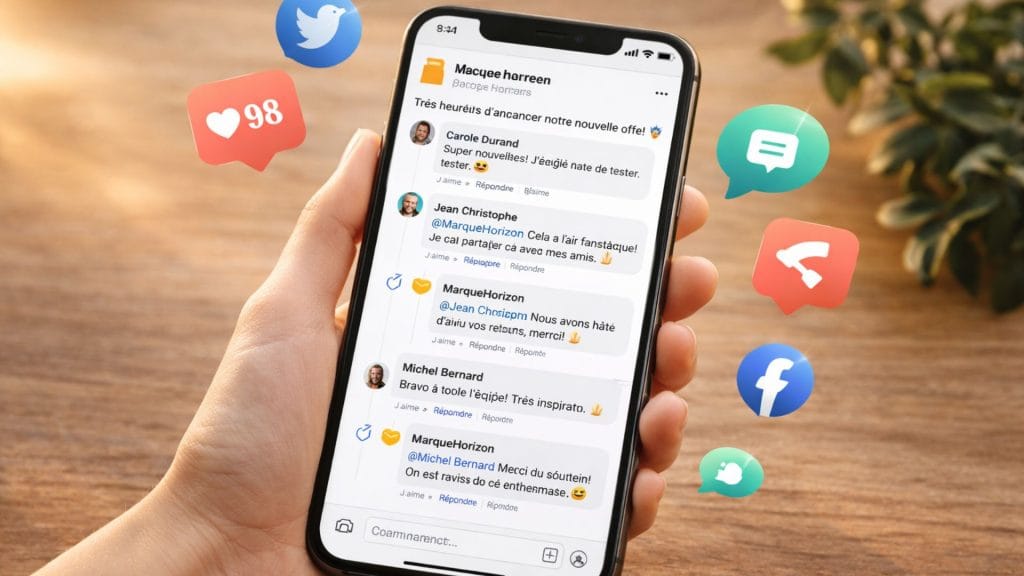
There’s a fundamental difference between having followers and having a community. Followers are numbers on a dashboard. An online community is about members interacting, responding, sharing and speaking out. This distinction determines your entire content strategy.
To turn your followers into an engaged community, you need to give them reasons to get involved: exclusive content, behind-the-scenes insights into your business, polls, open-ended questions, competitions, highlighted customer feedback. Thecommunity animator plays a central role here: he or she doesn’t just publish, he or she maintains the dialogue, moderates exchanges, and keeps the momentum going even in slow periods.
A well-run community gradually becomes an autonomous loyalty tool: it’s your members themselves who recruit new members, defend your brand in the event of negative feedback, and generate spontaneous content on your account. This is the model towards which all community management strategies should aim.
Statistical analysis: understanding what your community expects
Effective community management doesn’t just happen by feel.Regular analysis of your networkstatistics is what allows you to understand what really resonates with your audience, and adjust your strategy accordingly.
Which content generates the most engagement? Which publication days and times are most effective? Which topics trigger shares and comments? How has your brand awareness evolved over the last six months? It’s this data that guides the intelligent planning of publications, the updating of the content calendar and the choice of hashtags. This information can also be used to guide targeted advertising campaigns.
Monitoring your competitors and trends in your field completes this dashboard. It enables you to stay relevant, detect opportunities, and anticipate your audience’s expectations before they even express them.
Choosing the right networks: quality rather than quantity
An entrepreneur who tries to be active on all social networks at once generally ends up performing poorly on none. Lack of time is the number one constraint for SME managers and their teams, and dispersing energy over all channels is the best way to produce mediocre content on each of them.
The absolute priority is to choose two or three networks according to your sector of activity, your target, and your objectives – and then to be really present, regular and relevant. A well-maintained account on two platforms is infinitely better than a ghostly presence on five.
Which social network for which industry?
Facebook: a must for local BtoC, local businesses, craftsmen and restaurateurs. The Facebook store lets you present your product catalog directly in the application. Ideal for SMEs targeting a local audience aged 30 and over.
Instagram: indispensable for any activity linked to images, decoration, fashion, beauty, catering, tourism or crafts.Visual brand identity is king. Reels offer organic online visibility that will still be significant in 2025.
Pinterest: often forgotten by French SMEs, this visual search engine is particularly powerful in the decoration, wedding, cooking, gardening and fashion sectors. Its users come to it with a well-formed intention to buy, making it a highly effective conversion channel for online stores and artisans.
LinkedIn: the network for professionals, mandatory for all BtoB companies. It’s also a powerful lever for BtoC SMEs looking to recruit, develop partnerships or consolidate their professionalism.
TikTok and YouTube: video content creation platforms not to be ignored if your sector lends itself to teaching or entertainment. Hairdressers, coaches, trainers, restaurateurs, artisans: many SMEs have increased their online visibility tenfold thanks to video community management.
The skills of a community manager: much more than just publishing posts
The definition of a community manager is often unclear in the minds of SME managers. We imagine someone who writes posts or publishes photos on Instagram. The reality is far more comprehensive and complex. That’s precisely why the skills required are so numerous and demanding.
A good community manager is responsible for designing and planning the editorial calendar, creating content adapted to each platform (visuals, texts, videos, stories), moderating comments and replying to messages, managing customer feedback and any crises, monitoring statistics and reporting, keeping an eye on the competition and the sector, and coordinating with the company’s other communication media.
It’s a mission that requires the ability to translate a strategic vision through editorial, graphic, analytical and interpersonal skills. Versatility is the hallmark of good community managers, and it’s hard to find.
Community management turns your networks into a sales channel
Beyond communication, social networks for SMEs have become true distribution channels. The Facebook and Instagram online store lets you showcase your new products, receive orders and highlight targeted promotions – all without the extra cost of creating an e-commerce site.
Targeted advertising campaigns on these same platforms enable you to reach precisely the profiles that correspond to your target: age, location, interests, purchasing behavior. With a controlled budget, a concrete example of acquisition via Meta Ads can generate results far superior to traditional search engine optimization – particularly for companies selling products with a strong visual dimension.

Should you use a communications agency for your community management?
It’s a legitimate question, and the honest answer is: it depends. Some small business owners are comfortable with the tools, have the time, and naturally have a flair for communication. For them, one-off support is often all that’s needed to implement best practices and define a community management strategy.
But for the vast majority of small business owners, community management is an assignment, often entrusted to a trainee, that falls flat due to lack of time, regularity, or perspective on their own communications. And that’s precisely where an agency makes the difference.
The advantages of community management by a digital marketing and communications agency
Entrusting your community management to a specialized agency is above all a choice of professionalism. We take a rigorous approach to content creation: optimized texts, visuals consistent with your brand identity, and publication planning designed to maximize engagement.
Tailor-made communication strategies are another key benefit. An agency takes the time to analyze your sector, your competitors, your targets, and your objectives before defining the right channels and messages. It doesn’t apply a generic model to all its clients – it builds a social strategy tailored to your business, your image, and your budget.
Last but not least, detailed analysis of results is what distinguishes amateur community management from professional community management. Reporting tools enable you to track the evolution of your reputation, measure the return on investment of each action, and adjust your strategy in real time. It’s this analytical discipline that transforms your network presence into a genuine lever of credibility and, ultimately, into measurable business results.
Develop your brand with consistent, sustainable community management
Success on the networks isn’t built in a week. It takes hard work, regularity and constant adjustment. The big brands that seem to effortlessly dominate social networks have entire teams behind them, dedicated budgets, and years of constant presence.
For an SME, the smart alternative is to work with a networking expert who knows your sector, masters all the networks, and can propose a strategy tailored to your size and budget. No subcontracting to trainees, no over-investment in useless tools: just targeted, pragmatic, results-oriented support.
Let us manage your social networks – discover our offers
Social networks, a strategic asset that your SME can no longer ignore
Community management is not a luxury reserved for large companies. Today, it’s a communication channel in its own right, a highly effective customer loyalty tool, and a lever of credibility in your market, provided it’s managed with method and continuity.
It’s time to think ahead! Don’t take social networks seriously only when the competition outstrips you. Take them seriously now, choose the right networks for your business, build an authentic online community, and turn your followers into brand ambassadors. It’s this in-depth work, carried out with the right skills and tools, that will make the difference between an online presence that exists and one that performs.
Frequently asked questions about community management from our SME customers
Is Community Management useful for small and medium-sized businesses?
Yes, without reservation. Small companies even have an advantage over large ones: their proximity to customers, their authenticity, and their ability to react quickly are formidable assets on the networks. Well-managed community management can increase visibility, retain existing customers and attract new prospects, without requiring a disproportionate budget.
How long does it take to get results?
Community management requires constant effort, and the results also depend on your objectives. Building an online community can take months or even years. However, the more you share your social network links with your customers, whether in your store, on a website or on business cards, the faster your community will grow. Effective community management and the quality and consistency of your posts in relation to your target audience’s expectations will also have a major impact. And don’t forget to share promotions, news or competitions, for example. It’s a virtuous circle that will, in turn, drive traffic to your site and, where appropriate, to your online or physical store.
Do BtoB companies also need to be visible on social networks?
Absolutely. Today, LinkedIn is indispensable for any company selling to professionals. It’s the only social network offering precise targeting by function, sector and company. Beyond visibility, it’s a powerful lever of credibility: regularly sharing your expertise in your field establishes your reputation as an expert and generates new qualified prospects over the long term. LinkedIn allows you to build a brand image in line with your customers and prospects, and to highlight the experience of your company and its employees.
Which networks are the most effective?
There is no universal answer. The effectiveness of a network depends entirely on your sector, your target, and your objectives. What is certain is that it’s better to master two good networks than to be diluted on all of them. An experienced community manager can help you identify the right networks for your business, and focus your energy where it will produce the best results.
How much does a community management agency cost?
The cost varies according to the level of service, the number of platforms managed, and the frequency of publications. But the mistake would be to reason solely in terms of expenses: professional community management is an investment whose return is measured in visibility gained, customers retained, and new prospects generated. A serious agency will provide you with an offer tailored to your budget and your real objectives.
Is it really necessary to use an agency for community management?
Not necessarily in all cases. If you have the time, skills and regularity, you can manage part of your community management in-house. On the other hand, delegating to an agency guarantees you a coherent strategy, quality content and rigorous analytical follow-up – which makes all the difference between a stagnant online presence and a growing community.
I don’t have much of a budget. Is it worth having a community manager?
Yes, even with a limited budget. The use of organic social networks, i.e. without paid advertising, remains accessible to all businesses. The key to success lies not so much in the budget as in the regularity and relevance of content, and the quality of engagement with your community. A community manager can help you define a sober, effective strategy, and identify high-impact actions with minimal investment.