

La e-commerce site creation has never been so easy. A few clicks, a “turnkey” theme, three smart plugins… and your online store is on the web.
Yet this apparent simplicity hides a less rosy reality: simply putting a sales site online guarantees neither traffic, nor conversion, nor profitability.
In 2026, an online sales site will no longer be judged solely on its design or product display.
It will be evaluated on its ability to perform, anticipate customer behavior, and produce reliable data to drive the growth of your online business. And this is precisely where many projects fail – often before they’ve even really got off the ground.
This article has a clear objective: to help you avoid the mistakes that are costly – strategically and budgetarily – even before you get your store out of the shadows. The content is professional and educational… but with no tongue in cheek.
Discover our e-commerce website creation services
Thinking that the creation of an e-commerce site is limited to design and product sheets
All too often, online business owners start a website project with the graphic charter or product selection. Poor prioritization.
A high-performance sales site should be designed as a business tool in its own right, not just a digital business card. The user experience, the tree structure, the buying path, the “reason to buy” pages – all of this needs to be defined before choosing a theme or working on the look and feel.
What needs to be defined in the brief
Before starting the project :
- Precise sales objectives (target sales, catalog size, business sector)
- The optimal navigation path to turn your visitors into customers
- Requirements in terms of dashboard functionality and access
- Online communication and visibility strategy
Case in point: a store selling online courses has different needs from a retailer distributing physical products via several sales platforms.
Don’t define functionality precisely from the outset (and see your budget skyrocket).
“We’ll add that later.” This phrase is a time bomb that can blow up your bank account.
Elements that must be taken into account prior to design
Before creating your online store, you need to define exactly :
- Online payment methods (credit card, PayPal, split payment, Apple Pay)
- Delivery rules and methods (shipping costs, choice of carrier, international delivery)
- Product management (number of products, variations, real-time inventory)
- Automations (invoices, follow-up e-mails, upsell, cross-sell)
- CRM/ERP synchronization for a unified view of your business
- Customization options to suit your field of activity
- Transaction fees for different payment solutions
Without this framework, every plugin you add becomes a hidden cost, a maintenance point, a risk of bugs and a drop in performance. You also run the risk of discovering along the way that your solution doesn’t support certain services essential to your business model.
👉 Chez Altosor, notre approche est toujours de commencer par un cahier des charges fonctionnel clair, pour éviter les dépenses surprises en cours de projet. Découvrez comment nous vous accompagnons dans notre page dédiée.

Choosing an e-commerce solution without thinking about medium-term evolution
WooCommerce, Shopify, PrestaShop… these aren’t just tools, they’re ecosystems that structure your online business.
The pitfalls of choosing based on price alone
A choice based on the initial rate can backfire within 18 to 24 months:
- Functional limitations that block your growth
- Hidden costs of third-party applications (which add up quickly)
- Technical dependence on a single publisher
- Barriers to internationalization (multi-currency, multi-language management)
- Limited compatibility with certain marketplaces
- Trial period often too short for testing (only 30 days in some cases)
- Difficulty of access via computer or cell phone, depending on the solution
Criteria often overlooked – e-commerce site creation
- Ease of day-to-day management (how comfortable are you with it?)
- Available fonts, layouts and customization options
- Integration with your target marketplaces
- Robust support team and suite of available tools
- The design solution must match your technical level
Don’t hesitate to call on one of our professionals to guide you in choosing the best CMS to avoid revisiting your choice in 18 months’ time.
Registering your domain name without a strategy: an underestimated mistake
Your own domain name is much more than just a web address. It’s your digital identity, your brand, your credibility with search engines.
Common mistakes when creating an e-commerce site
- Choosing a domain name that is too long or complex
- Do not check availability on social networks
- Forgetting to protect alternative extensions (.fr, .com, .eu)
- Not anticipating the evolution of your field of activity
What to do
- Choose a short, memorable domain that represents your business
- Check for similar trademarks
- Secure multiple extensions to protect your brand
- Think SEO when choosing a name (avoid multiple hyphens, ambiguous numbers)

Launching an e-commerce site without GA4, Google Tag Manager and Google Merchant Center
This is where many projects falter in silence. And it’s also one of the most costly mistakes to make in the long term.
Why GA4 and GTM are essential
Without Google Analytics 4 (GA4) coupled with Google Tag Manager (GTM), you’re not measuring your business, you’re guessing. Understanding customer behavior is essential to running an online store.
In GA4, you can :
- Calculate precise conversions (purchases, additions to cart, product page views)
- Measure the impact of your online advertising and communication campaigns
- Analyze performance by acquisition channel (SEO, SEA, social networks, email)
- Understand your visitors’ complete path to conversion
Technical configuration: a must
GA4 uses an event model to track specific actions such as adding to cart or initiating payment. These events must be correctly configured via Google Tag Manager to guarantee reliable data.
For e-commerce, GA4 needs to be coupled with a structured data layer to correctly track key actions. Without this technical architecture, your data will be incomplete or unusable.
The official Google documentation shows how to set up e-commerce data collection via events in GA4 and GTM.
RGPD compliance: a legal AND strategic imperative
And when it comes to confidentiality, the CNIL imposes strict rules on the use of cookies and tracers, requiring explicit prior consent from users.
In 2025, the CNIL will require cookie banners with a “Refuse all” button placed at the same level as “Accept all”. The simple continuation of browsing can no longer be considered valid consent.
Data protection : Beyond the legal aspect, transparent cookie management reinforces trust and improves your visibility with an audience that is increasingly sensitive to privacy issues.
To put it plainly: if you don’t integrate these building blocks from the outset, you’ll be steering blindly, and taking unnecessary legal risks.
Neglecting SEO and search engines right from the start
Search engine optimization is not a bonus added after the site goes online. It’s an integral part of building a high-performance website.
SEO fundamentals to be integrated right from the design stage
- Permalink structure (clear, short URLs with keywords)
- Optimized title tags and meta descriptions for each page
- Hn logical hierarchy (H1, H2, H3) on all pages
- Structured internal meshing for easy navigation and indexing
- Performance and Core Web Vitals (loading time, interactivity)
- Optimization of product sheets with unique descriptions and targeted keywords
- Content strategy for search engines
SEO mistakes that kill visibility
- Automatically generated URLs such as “product-12345”.
- Duplicate product sheets or those taken over from suppliers
- A website that’s too slow to load (penalized by Google)
- No keyword strategy adapted to your sector
- Overly complex navigation architecture
SEO needs to be thought through right from the start. Otherwise, correcting it afterwards is like rebuilding a floor on a shaky foundation – with all the costs and delays that entails.

Forget RGPD compliance and consent (and skew all your data).
RGPD compliance isn’t legally optional – it’s strategic.
The consequences of non-compliance
Collecting data without valid consent = distorted data + risk of sanctions + loss of customer confidence.
In 2025, around 70% of e-commerce sites are still not RGPD-compliant, exposing themselves to fines of up to 20 million euros or 4% of global sales.
Recent sanctions show the increasing severity of the authorities: Google was fined 325 million euros for dark patterns in consent management, Shein 150 million for depositing cookies before consent.
What the RGPD means in concrete terms for e-commerce
- Clarify the purpose of cookies and tracers as soon as you enter the site
- Segment marketing vs. transaction processing
- Secure customer data (encryption, restricted access, protection)
- Offer users a real choice (refusal as easy as acceptance)
- Document treatments in an up-to-date register
- Training teams to manage personal data
Users must give their prior consent to the placement of certain cookies, and must be able to withdraw this consent at any time via a permanently accessible mechanism.
The RGPD guide for merchant sites – Info-Ecommerce details all the practical points you need to respect for your online store.
Creating a sales site without a clear acquisition strategy
Traffic is good. Having the right traffic is better. And having a strategy to convert it is essential.
E-commerce is a multi-channel ecosystem
SEO, SEA, social networks, retargeting, email, marketplaces, advertising… a high-performance sales site is a central hub in a diversified acquisition ecosystem.
French e-commerce grew by 7.9% in the first half of 2025, and the European market is expected to exceed 915 billion euros by 2025. With this growth comes increased competition, requiring a solid acquisition strategy.
Levers to think about even before development
- Omnichannel journey (consistency between all points of contact)
- Conversion attribution (which channel actually generates sales?)
- Audience segmentation (who are your customers, how do you reach them?)
- Realistic advertising budget based on your sales targets
- Integration with marketplaces (Amazon, Cdiscount, Fnac Darty…)
- Coherent online content and communication strategy
Let’s discuss your online store project
New trends for 2026
Social commerce is gaining momentum with the integration of purchasing processes directly into Instagram, TikTok and Facebook. Generative artificial intelligence is revolutionizing customer relations, with AI agents capable of assisting buyers 24/7.
Live shopping is emerging as a key trend, with over 70% of European consumers attracted to this interactive, conversion-boosting format.
Our advice: Before even starting development, it’s essential to think strategically about your priority channels. Don’t rely on SEO alone – diversify from the outset.
Thinking that “putting something online” means “selling it
(Spoiler alert: it absolutely doesn’t work like that).
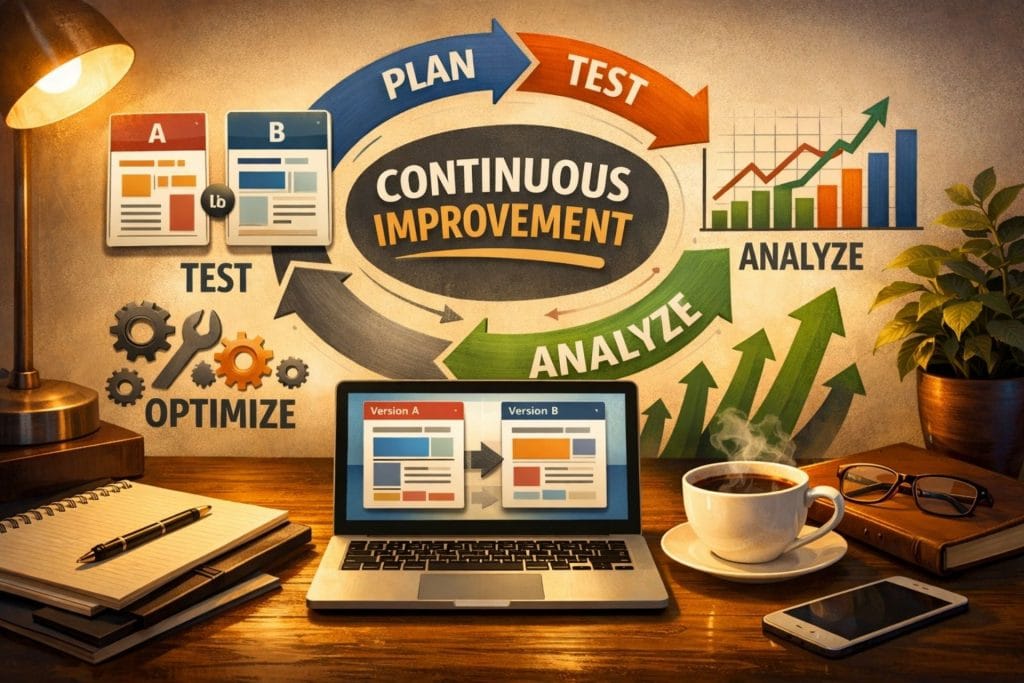
An e-commerce site is never finished
We test, measure, optimize, correct and adapt. Constantly.
If you think going live means “mission accomplished” – get ready to scale back your goals. Seriously.
Essential post-launch actions
📊 Tests A/B réguliers sur les pages clés (fiches produit, tunnel de commande)
📈 Analyse des données GA4 pour identifier les points de friction
🔧 Optimisations techniques continues (vitesse, navigation, compatibilité mobile)
💬 Collecte et intégration des retours clients pour améliorer l’expérience
🎯 Ajustement de la stratégie marketing selon les performances réelles
📦 Surveillance de la concurrence et adaptation de votre offre
In 2026-2027, performance will be fine-tuned: margin, LTV (customer lifetime value), logistics and customer loyalty are the real indicators of success, far beyond simple sales.
That’s exactly why we always recommend an ongoing post-launch support phase, with regular cycles of testing and improvement. Because as your store evolves, so will the market – and your site must keep pace.
In 2026, an e-commerce site is no longer created, it is thought out
Creating an online sales site in 2026 is no longer a purely technical issue:
➡️ It’s a strategic, data-driven and performance-oriented issue.
The mistakes listed above are not obstacles in themselves… as long as you avoid them before you start.
Your checklist before launching your project
Your online store must be :
- Controllable with good data (GA4, GTM configured correctly)
- Optimized for conversion (UX, path, product sheets)
- Legally compliant (RGPD, cookies, data protection)
- Integrated into a coherent acquisition strategy (SEO, SEA, social, email)
- Technically scalable (solution adapted to your growth)
- Secure (online payment, customer data, administrator access)
- High-performance (loading time, fluid navigation, mobile-first)
And that’s before it even goes online. That’s the real difference between a site that exists and one that performs.
Discover our article: 20 levers to optimize your e-commerce site
Free consultation with an e-commerce expert
FAQ – Creating an e-commerce site
How much does it really cost to create an online sales site?
Prices vary considerably according to functional requirements, catalog size (number of products), professional support, technical infrastructure and integrated services. From €3,000 for a basic solution to over €50,000 for a customized platform.
Which e-commerce solution to choose in 2026?
There is no one-size-fits-all solution – it all depends on your business model, sales volume, internationalization needs and marketing strategy.
WooCommerce: Flexible, open-source, ideal for WordPress
Shopify: Turnkey, excellent support, limited customization
PrestaShop: Free, powerful, but requires technical skills
Magento: For large volumes, complex, requires a dedicated team
→ Call on our expertise to choose the solution that’s right for your business and your project.
Do I need to install GA4 as soon as I create my website?
Yes, absolutely. Without GA4 and a good tracking structure, your ability to understand and optimize will be severely limited. It’s like flying a plane without instruments – technically possible, but downright risky.
Is it possible to create an online store without calling in a professional?
Technically yes, but without expertise in UX, SEO, tracking and acquisition strategy, you run the risk of going back and forth, incurring unnecessary expenses and, above all… wasting precious time. The cost of a poor start-up often far exceeds that of professional support from the outset.
When does an e-commerce site become profitable?
This depends on your business sector, your acquisition strategy, your margin, your operating costs (transaction fees, shipping costs, advertising) and your ability to optimize on an ongoing basis – not just when it goes online. On average, allow 6 to 18 months to reach profitability, depending on investments and market.
How can I get my online store listed on Google?
SEO combines several aspects: a technically optimized website, quality product sheets, an SEO content strategy, consistent internal linking, quality backlinks, and an active presence on Google Merchant Center for shopping. A visitor’s head will only turn to your site if you’re visible – hence the importance of a comprehensive strategy right from the start.