

Your competitor appears in ChatGPT responses. Perplexity cites it as a reference and Gemini recommends it to its users. But what about you? You don’t exist. It’s not a question of chance. It’s a question of knowing how to seize the opportunities offered by Generative Engine Optimization, the new mode of natural referencing. While most SMEs are still unaware of what this means, the more agile are already beginning to master GEO thanks to their foresight.
This comprehensive guide explains what GEO is, how it’s changing the rules of online search, how artificial intelligences choose their sources, and above all what you can do to gain visibility in these new engines.
GEO : What is Generative Engine Optimization?
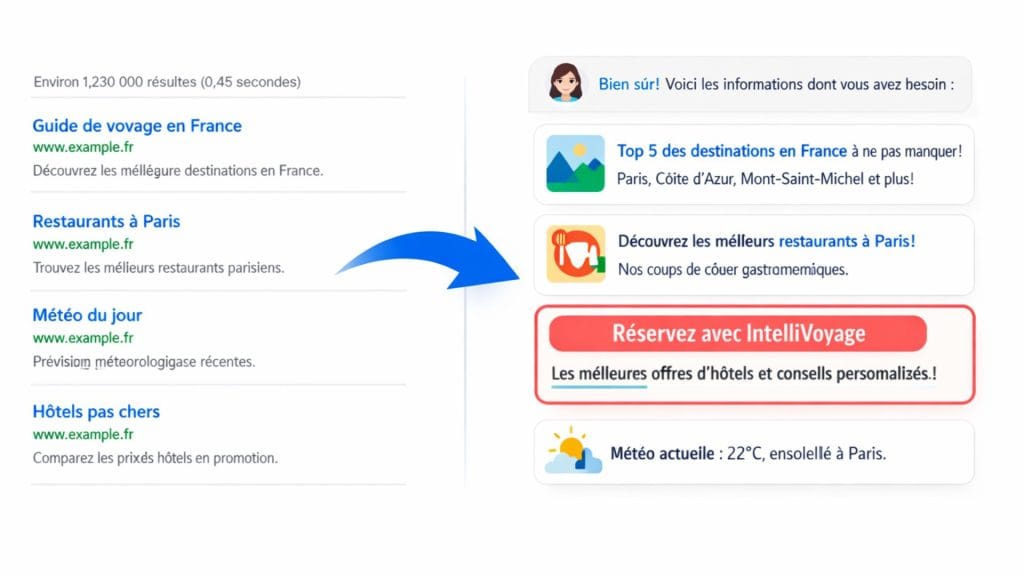
Generative Engine Optimization or GEO refers to the set of techniques designed to optimize content so that it is selected, quoted and redistributed in responses generated by conversational AIs. Where conventional SEO seeks to position a page in a list of search engine results, GEO has a different objective: to ensure that your content becomes the source that the AI chooses to mention directly in its response.
In other words, it’s no longer a question of being included in a list of links that the surfer has to click on. It’s about being integrated into the response flow itself, where attention is first drawn.
This paradigm shift is driven by the explosion in the use of generative AI. ChatGPT exceeds 500 million weekly users by 2025. Perplexity processes hundreds of millions of queries a month. Google deploys its AI Overviews on a massive scale. These new search engines don’t work like their predecessors: they synthesize, reformulate and cite their sources.
GEO in a nutshell
Generative Engine Optimization consists in making your content sufficiently structured, reliable and authoritative for AI search engines to choose it as a reference in the responses they generate.
What’s the difference between GEO and traditional SEO?
The difference between GEO and search engine optimization is fundamental, even if the two disciplines share common ground.
SEO: optimizing for a list of results
Traditional SEO relies on search engine ranking algorithms that evaluate hundreds of signals: keywords, backlinks, loading speed, site structure. The algorithm then assigns a score to the page, which positions it in the Google search results. Internet users obtain a list of results, choose a link and consult the page. The challenge is to be as close as possible to first position.
GEO: optimizing for direct response
AI search engines, such as ChatGPT, Claude, Gemini or Perplexity, don’t offer a list. They generate a direct response, synthesized from multiple sources. The content of your site is no longer read after a click: it is absorbed, analyzed, and potentially quoted. The generation of responses by AI relies on language models capable of processing natural language on a very large scale – the famous large language models, or LLMs.
In practice: a manager asking ChatGPT “which communications agency to choose for an SME in France” won’t see a page of search results. Instead, he’ll receive a written answer, with two or three names mentioned. If you’re not there, you don’t exist for that user.
What SEO and GEO have in common
Both disciplines require quality content, established credibility and a sound technical structure. Google’s E-E-A-T criteria (Experience, Expertise, Authority, Reliability) also form the basis of a successful GEO strategy. GEO does not replace SEO: it complements it. AI engines still rely heavily on the web indexed by Google to feed their responses.
How AI search engines select their sources
Understanding how AIs choose their sources is the key to GEO. Unlike Google, which publishes its search criteria (Quality Rater guidelines, algorithm updates), AI search engines like ChatGPT or Perplexity don’t precisely explain their selection rules. But ananalysis of the sources actually cited reveals clear patterns.
Source authority
AIs prefer content from sites perceived as expertsin their field. A site that deals with a subject in depth, consistently and regularly, will be cited more often than a generalist site that touches on a subject once a year. The credibility perceived by AI depends to a large extent on the authority signals already present on the web: mentions in recognized publications, positive reviews, presence in reference directories.
Fresh, relevant content
Conversational AIs connected to the web in real time – such as Perplexity or ChatGPT with navigation enabled – place particular importance on fresh content. Regularly publishing in-depth articles, updating existing pages, and covering recent developments in your sector are direct levers for appearing in their responses.
Structure and legibility for machines
AI engines analyze content in a different way to a human. They look for direct answersto user queries. Content structured as questions/answers, with clear definitions, sourced figures, and an explicit header hierarchy, will be much more easily extracted and cited. Rich snippets, FAQs and structured data(schema.org) send strong signals to response engines.
Third-party mentions and off-site reputation
Like netlinking in SEO, GEO values third-party sourcesthat talk about you. Online press, industry blogs, specialized forums, Wikipedia, Financial Times or other reference publications: every citation of your brand or domain in a reliable source strengthens your presence in the AI engines. This is what we call the “LLM Share of Voice”.
[IMAGE 4 – Suggestion: diagram of the 4 levers of source selection by AI (authority, freshness, structure, third-party mentions)]
GEO : Why IA search engine optimization has become essential
The figure is stark: according to Gartner, 25% of traditional search volume could disappear from conventional search engines by 2026, absorbed by generative AI. This is not a theoretical projection, but an already measurable development. On queries displaying an AI Overview in the Google SERP, the organic click-through rate dropped by 61% between 2024 and 2025, according to Ahrefs.
According to IPSOS 2025, 39% of French people are already using generative AI for their research. Today, this figure mainly includes working people, decision-makers and executives – precisely your target audience if you’re a B2B SME or service provider.
Breaking the user path
The online searchexperience has changed radically. Users no longer browse from link to link: they ask an AI a question, get a synthesized answer, and make a decision. Conversational chat replaces the dry query. In this context, the question is no longer just “Am I on page 1 of Google?”, but also “Do AIs quote me when people talk about my sector?
An opportunity for SMEs to get ahead of the game
The good news is that GEO is still in a testing phase for most players. Market share in this field has yet to be won, although some players are beginning to stand out. SMEs that invest in a GEO strategy now have a real head start over their competitors, who have not yet taken the measure of this extremely rapid evolution. It’s a rare window of opportunity, with undeniable benefits in terms of credibility.
The growing importance of the Google alternative
Theimportance of GEO is also due to the diversification of engines. Users are no longer dependent on a single engine. Perplexity, Gemini, Claude, Copilot: the interfaces are multiplying, and each has its own citation criteria. Being present on all these AI search engines requires a coherent, cross-functional strategy.
How much traffic does GEO generate?
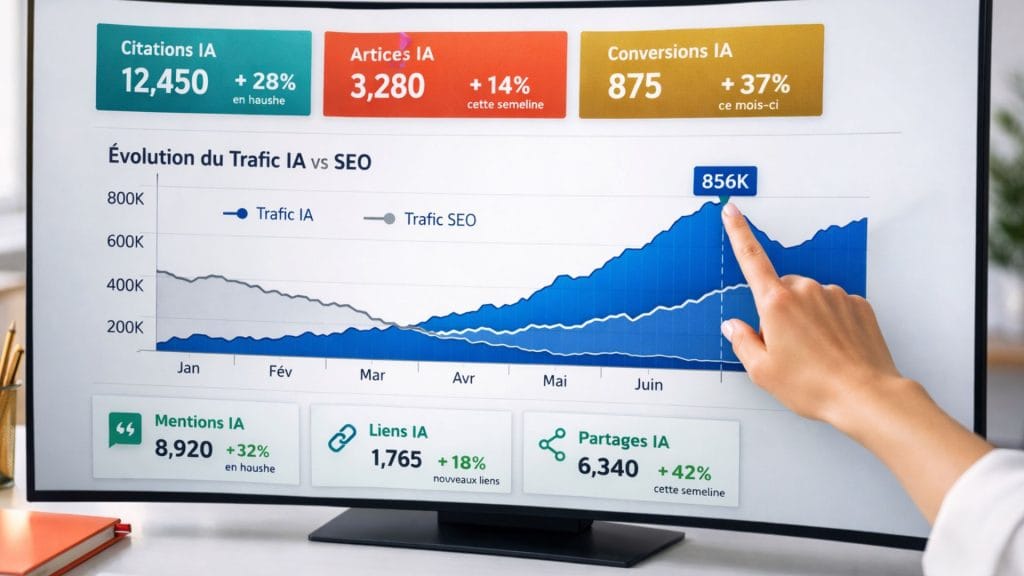
The question of GEO traffic is a legitimate one, and the first data available are encouraging. Traffic from AI engines like ChatGPT is estimated to have a higher conversion rate than conventional organic traffic: users who click on an AI-cited source are actively looking for an AI solution, often in the evaluation or decision-making phase.
On the other hand, the gross volume of GEO traffic is still lower than traditional SEO for the majority of sectors. This is why the recommended strategy is a combined approach: maintain and optimize your traditional SEO while building a presence on AI search engines. The two are mutually reinforcing, as AIs rely on the web indexed by Google.
The first GEO signals generally appear between 3 and 6 months, depending on the sector. This timeframe is comparable to that of organic SEO, which reinforces theimportance of acting now rather than waiting until the market is saturated.
How to optimize your site for GEO: best practices
Optimizing content for GEO relies on a series of levers that can be activated, even by SMEs without a dedicated technical team. Here are the key stepsto an effective GEO strategy.
1. Building a strong thematic authority
AI search engines prefer sites that cover a subject in depth and in a coherent way. The point is not to publish en masse, but to create content that is a real reference in your field. A comprehensive guide, a detailed customer case study, an exhaustive FAQ on your business: these are formats that AIs know how to exploit. Content creation should be guided by users’search intent, not just keywords.
2. Structuring content for machines
Adopting a clear structure is one of the most direct levers. Hierarchical title tags (H1, H2, H3), Schema.org structured data, short paragraphs that answer a precise question at the beginning of the text: these are all good practices that make it easier for LLMs to extract your content. Question-and-answer formats are particularly effective, as they correspond directly to the context of queries formulated in conversational AI.
3. Strengthening E-E-A-T credibility
Transparency about the author, industry references, customer reviews on third-party platforms (Google Reviews, Trustpilot) and presence in quality directories reinforce the trust that AI engines place in your domain. Every signal of legitimacy counts. Mentioning sourced data, citing studies, signing articles with an identifiable author: these simple elements have a measurable impact on your visibility in generative AI.
4. Enable third-party mentions
Seeking to be quoted in reference publications – industry press, expert blogs, trade associations – is the perfectexample of a high-leverage GEO action. AIs give far superior performance to sources that already enjoy recognition on the web. Press relations and citation guides are directly useful tools here.
5. Monitor your visibility in AI
GEO deep monitoring consists of regularly testing a set of strategic queries on the various AI engines, and measuring whether your brand or domain is cited in them. Specialized tools are beginning to emerge to automate this monitoring. Regularanalysis enables you to adjust your strategy as language models are updated.

How do I know if I’m visible in AI?
That’s the practical question most managers ask. The simplest and most immediate method: manually test queries representative of your business in ChatGPT, Claude, Perplexity, Gemini and Copilot. Formulate the question as a potential customer would: “What’s the best communications agency for an SME in [city]?” or “How do I choose an SEO provider in France?”.
If your brand or site doesn’t appear in the responsesof these AI search engines, it’s a clear signal that your content isn’t yet perceived as a source of reference by the AIs. This diagnosis is an essential step before deploying a GEO strategy.
Dedicated alternative tools such as Brand24, Mention or specialized GEO solutions can also be used to automate this learning process and measure the evolution of your visibility in generative AI over time.
Altosor Communication guides you in your GEO strategy
At Altosor Communication, we’ve integrated Generative Engine Optimization into our SEO offering because we believe that online visibility can no longer be limited to Google search results alone. AI engines have become crossroads of intent: your prospects go there, ask their questions, carry out their AI research prior to any purchase or contact.
Our approach combines auditing your current visibility in generative AI, optimizing your existing content, creating structured content for LLMs, and activating off-site authority signals. We leverage the best tracking tools available to measure theimprovement of your GEO traffic over time.
The question is no longer whether you should do GEO. It’s whether you want to go head-to-head with your competitors in AI, or leave them alone. You can count on the expertise of our SEO agency.
[IMAGE 8 Suggestion: team visual or Altosor interface with GEO tagline, brand professional style].
Frequently asked questions about Generative Engine Optimization
What is Generative Engine Optimization?
Generative Engine Optimization (GEO) is the set ofoptimization techniques that enable your content to be quoted in responsesgenerated by conversational AIs such as ChatGPT, Perplexity, Gemini or Claude. It complements classic SEO by targeting AI search engines rather than just traditional google search results.
What’s the difference between GEO and SEO?
SEO aims to position your website in a list of results on traditional search engines. We suggest you test your website’s SEO now.
GEO aims to be cited as a source directly in the AI-generated response. Both disciplines share the same foundations of content quality, but diverge on their final objective andoptimization techniques.
Request a free quote from our SEO Paris agency.
How do I optimize my site for GEO?
GEO best practices include: structuring your content into clear questions/answers, building your thematic authority, publishing regular, sourced articles, enabling Schema.org structured data, and working third-party mentions into reference sources. Theaim is to be perceived as a reliable expert by language models.
GEO: Why do search engine optimization with AI?
Because 39% of French people are already using generative AI for their searches (IPSOS 2025), and this generative search is capturing a growing share of queries with high search intent. To be absent from these AI search engines is to be invisible to a growing portion of your most qualified prospects.
Does GEO account for a large share of traffic?
GEO traffic is still emerging in terms of absolute volume, but it has high conversion potential. Users who click on a source cited by an AI are in an active decision-making phase. The recommended course of action: build a GEO strategy now to be positioned when volumes mature.
Why has GEO become essential for content creation?
Because generative AI is structurally transforming online search. AI engines no longer offer a list of links to browse: they provide a complete answer. If your content isn’t among the selected sources, no line about you will appear in the AI’s responses. As a result, you’ll slip under the radar of future customers and prospects. E-commerce sites will see a big increase in their sales coming from quotes from AI platforms, as shown in this article on ChatGPT Shopping.
How do I know if my SME is visible in the results of generative AI?
Manually test queries related to your business in ChatGPT, Perplexity, Gemini and Copilot. If your brand is not cited, this is a signal that a GEO strategy is required. The Altosor communications agency offers a GEO audit guide to assess your current visibility in AI search engines and identify the players who are ahead of you in AI responses.
Want to know where you stand with AI engines? Contact Altosor Communication for a GEO audit of your visibility.